Skip to content

Making State Aid Work for the Decarbonisation of Europe

The project is completed. It has made decisions of the EU Commission on state aid, relevant to climate protection and the energy transition, more transparent. Using well-documented case studies, it is now possible to understand what impact past state aid decisions have had on the energy transition.

Climate Policy Climate Strategies and Plans

Beitragsbild

Project info

Countries:

-

Project duration:

11/17 - 12/19

Target groups:

-

Funding:

274,522.76 €

Contact info

Contact:

Matthias Buck

Implementing organisation
  • Agora Energiewende, Smart Energy for Europe Platform (SEFEP) gGmbH
Partner:
  • Client Earth

Background

The first European Commission under the leadership of Ursula von der Leyen (President of the European Commission since 2019) set, within the framework of the European Green Deal, the objective of revising the EU State Aid Rules — the regulatory framework of the European Union that defines under which conditions Member States are allowed to support companies with public funds.

At the core of this reform were in particular the Guidelines on State Aid for Environmental Protection and Energy (EEAG) and the Guidelines on State Aid in the context of the EU Emissions Trading System after 2021 (ETS Guidelines), which determine how Member States may support energy-intensive industries within the emissions trading scheme.

The overarching goal of this project was to actively contribute to and shape the reform process. Furthermore, stakeholders (e.g. companies, environmental organisations, associations) and media outlets engaged in issues related to climate change and the energy transition were to be made aware of the relevance and internal coherence of state aid measures for decarbonisation (the reduction of CO₂ emissions) and the energy transition within the EU.

Find more information and material on state aid in the context of decarbonising Europe on Client Earth’s website.
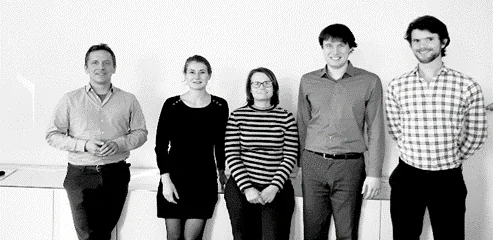
TeamPhoto: Matthias Buck, Juliette Delarue, Maria Kleis, Kevin Oswald, Sam Bright

Project

The project has processed and made accessible past decisions on state aid. In addition, it identified key steps and elements in state aid decisions that should be improved in order to link them more closely to the achievement of European climate and energy goals.

The project implementers Agora Energiewende and Client Earth used their legal, economic and energy expertise to develop an online database of their findings. They provided communication materials for 28 case studies in six thematic areas on EU state aid decisions.

In addition, the project brought together stakeholders and climate and energy experts to exchange views on the interplay between state aid and decarbonisation in the EU. They were also able to network with the European Commission, Members of the European Parliament and national governments on this issue through the project’s communication activities in Brussels and selected Member States and regions.

Results

  • Pooled expertise: The project developed six issue papers with analyses of 28 State aid decisions and 21 case studies on state aid in the context of decarbonization. These papers served as a sound working basis for decision-makers at the national and European levels, from representatives of civil society to industry and research, as well as members of the European Parliament, to effectively shape the reform of State aid rules.
  • Political and public impact: The project results resonated significantly in the public debate, including in at least twelve articles in leading international media outlets such as Politico, Euractiv, and Reuters. At the same time, eight political milestones were documented in which leading EU actors committed to aligning State aid policy with climate goals – a signal of a strategic impact beyond the project. These milestones included public statements by Luxembourg's Energy Minister Claude Turmes, the European Parliament hearing of Margrethe Vestager on her commitment to aligning EU state aid rules with the Paris Climate Agreement, and recommendations from the High Level Group on Energy Intensive Industries, which highlighted state aid as a key tool for industrial decarbonization. Key EU documents also addressed the topic – including the Commission's Communication on the European Green Deal (COM (2019) 640), the European Council Conclusions of December 12, 2019, and the European Green Deal Investment Plan (COM (2020) 21), which emphasized a "supportive state aid framework" as a prerequisite for sustainable investments.
  • Dialogue and strengthened network: Around 450 stakeholders participated in the project's events, and more than 46 key individuals were intensively involved. This resulted in an informal network of representatives from administration, politics, civil society and academia – with the common goal of aligning government funding practices in the EU Member States more closely with the EU decarbonization agenda.

Last update: January 2026

More about this project

Publications

publications
12 November 2020

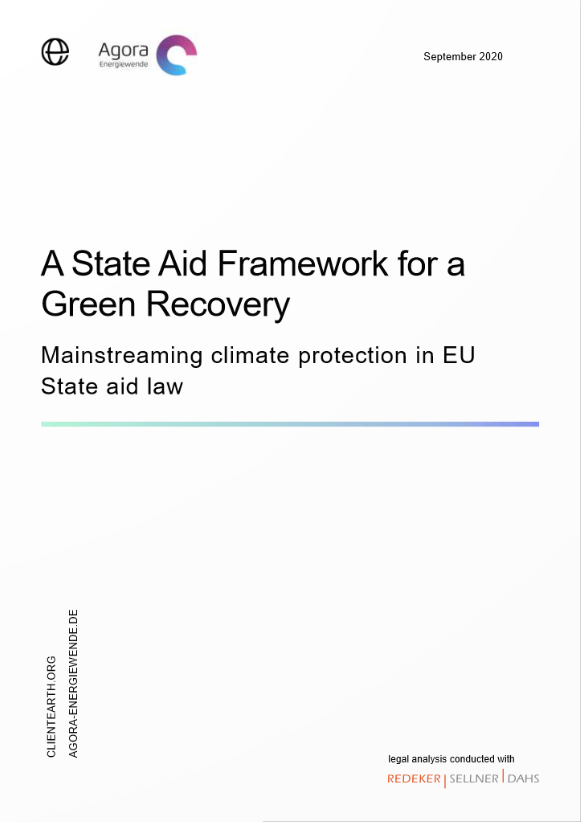
A State Aid Framework for a Green Recovery

publications
12 November 2020

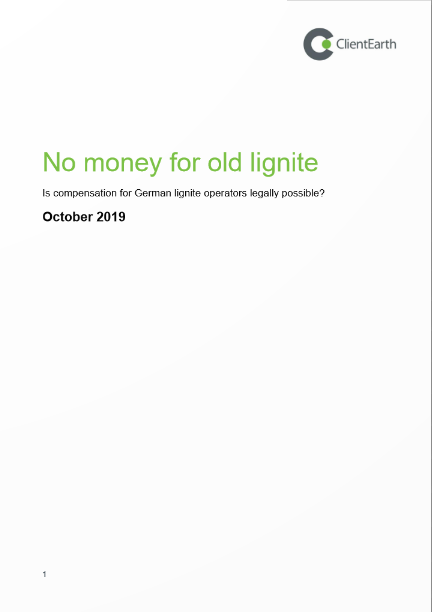
No money for old lignite