
Ready4NetZero – Long-term Climate-Neutrality Strategies in Towns and Cities
Supporting small and medium-sized cities in Croatia, Hungary, Poland, and Romania in developing and implementing local strategies to reach climate neutrality.
Climate Policy Climate Strategies and Plans Municipalities
Project info
Croatia, Germany, Hungary, Poland, Romania
11/22 - 04/25
Local governments, Non-governmental organisations, EU institutions, National governments, Private sector
401,856.29 €
Contact info
Izabela Kuśnierz
- Energiaklub Climate Policy Institute and Applied Communications Association (Energiaklub)
- North-West Croatia Regional Energy Agency (REGEA)
- The Romanian Network of Energy Cities / OER
Background
The European Union has decided to become climate-neutral by 2050. With more than half of its urban population living in small and medium-sized cities, they represent key players in this endeavour. Local long-term climate neutrality strategies, that guide the cities in the process, are critical for reaching the necessary socio-ecological transformation and managing a fair transition to local net-zero emissions. Generally, local authorities are very committed to climate action and willing to take efforts towards reaching climate neutrality. However, due to limited capacities, knowledge, technical expertise and financial resources, there is still room for improvement regarding properly planning their energy transition path.
Project
To address the above-mentioned challenges, the project offers various hands-on approaches. It provides written guidance on how to forward on the path to climate neutrality, as well as practical capacity-building activities, such as webinars, workshops, a study visit and an international conference. This equips municipal staff with the necessary knowledge, skills, and connections to develop and implement long-term climate neutrality strategies, involving the energy sector (energy utilities and consumers), transportation sector (transportation utilities and users), construction sector (construction companies, housing cooperatives and associations) and educational sector.
Furthermore, the project kick-starts concrete actions in eight pilot cities in Croatia, Hungary, Poland, and Romania to directly contribute to the implementation of climate protection measures at a local level and inspire other EU cities to follow. Among others, the pilot actions may include joint, bottom-up development of visions for reaching climate neutrality by 2050, mapping and involving stakeholders considered key drivers of the energy transition and developing roadmaps towards reaching net zero. The pilot will be supported by the knowledge gained during the study visit in Germany and the training events for the local decision-makers, staff, and civil society. The widespread media campaign will help to broadcast the project activities on a wider scale.
Highlights
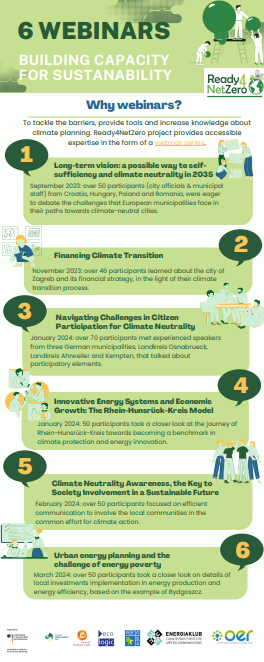
In this Onepager Ready4NetZero shares the results of their webinar series on capacity building. The project thereby tackled barriers in climate action, provided tools and increased knowledge about climate planning.
Last update: July 2024