MENERGERS – Energy Managers’ Services in Municipalities
Improving municipalities’ skills and expertise through exchanging good EU practices to become competent energy managers and reduce energy consumption in Bulgaria and Romania.
Buildings Energy Efficiency Energy Transition and Climate-Neutral Buildings Municipalities
Project info
Bulgaria, Germany, Romania
11/22 - 04/25
Local governments, National governments, Public sector, Non-governmental organisations
469,794.74 €
Contact info
Kamelia Georgieva
- Energy Cities Romania/ OER
- Energy Cities Romania/ OER
- Independent Institute for Environmental Issues UfU e.V. Berlin
- Sofia Energy Agency – SOFENA
Background
To achieve the European Union’s (EU) goal of becoming climate-neutral by 2050 involving local authorities in energy management is crucial. The EU’s launched REPowerEU Plan confirms the municipalities leading role in developing energy-saving measures tailored to their local context. However, in Bulgaria and Romania, this integral part of climate protection has not received sufficient attention so far. Competent authorities often lack relevant experience because of insufficient education and training opportunities in the two countries with regard to managing energy consumption, which is why they have little insight and control over it.
Project
Municipal administrations are essential in avoiding unnecessarily high levels of energy usage. Hence, the project implements measures such as research on good practices, legislation, and regulations. It is searching for curricula of energy manager trainings as well as the exchange of knowledge and experiences. National authorities’ representatives, civil servants responsible for climate and energy questions as well as environmental experts and energy managers then discuss these results within workshops, round-table discussions, public consultations, and conferences, which help develop a specified training programme. Eventually, these outcomes contribute to designing a free, easily accessible, and unique model for energy managers’ duties in Bulgarian municipalities. They furthermore create a communication platform and define criteria for renewable energy sources in Romania, which are then part of the requirements for funding local projects. In the end, the project drafts proposals to update the policy and legal frameworks in both countries after both the model and the results of the activities up to this point have been evaluated and verified. Additionally, the distribution of this information along with publicity actions increases awareness regarding the matter in the municipalities in both countries.
Highlights
To reduce energy consumption in Bulgaria and Romania EUKI project MENERGERS released reports, conducted trainings and provided room for exchange between municipalities via study visits.
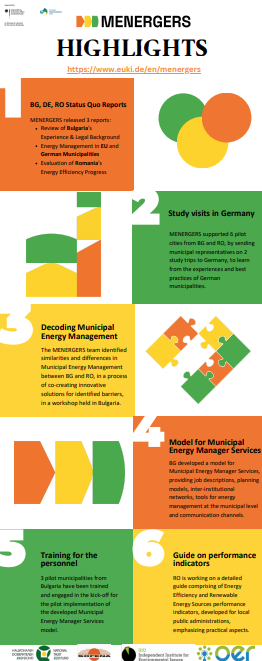
Infographic: MENERGERS HIGHLIGHTS
Last update: July 2024